The Baby Einstein Take Along Tunes has sold over 30 million units worldwide. That number suggests it’s doing something right, but popularity doesn’t automatically equal value.
We read through hundreds of customer reviews across multiple platforms and used this toy ourselves for several months with our 8-month-old to understand what it actually delivers. The patterns that emerged were surprisingly consistent.
This handheld music toy sits in that sweet spot between affordable and functional. It’s budget-friendly, plays 10 classical melodies, and gives babies a satisfying cause-and-effect experience when they press the big blue button. But it’s not perfect, and it won’t last years.
This review looks at what the Take Along Tunes actually delivers. The question we wanted to answer: Is it actually worth the money, or is it just well-marketed?
At-a-Glance Summary
Our Rating: ★★★★☆ (4/5)
Age Recommendation: 3+ months (manufacturer), 6-15 months (our experience)
What It Does: Plays 10 classical melodies with dancing lights
Battery: 2 AA batteries (included)
Best For: Car entertainment, portable distraction, classical music exposure
Worth It? Yes, if you accept the 6-9 month engagement window
Check Current Price of Baby Einstein Take Along Tunes
What You’re Getting
The Physical Toy
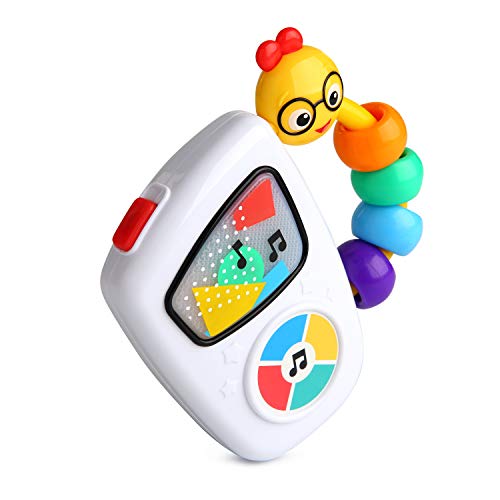
The Take Along Tunes measures 5 inches tall, 4.8 inches wide, and just over an inch thick. Light enough that babies can hold it without struggle once they develop grip strength.
Cal the Caterpillar is the character featured on the front. The large blue button sits in the center where babies naturally want to press. A chunky handle extends from the top with colorful beads that slide back and forth.
The entire body is smooth hard plastic. No sharp edges, no small parts that can detach. Baby Einstein designed this for mouths and drops, which is good because both happen frequently.
Behind the caterpillar graphic, a small screen lights up when music plays. The lights pulse and dance to the rhythm. Not bright enough to be distracting in a dark room, but visible enough for babies to notice.
The Button & Interface
One button controls everything. Press it once and music starts. Press again during a song and it skips to the next melody. After all 10 songs cycle through, it auto-shuts off.
The button requires moderate pressure. It’s not hair-trigger sensitive where accidental touches trigger it, but not so stiff that developing finger muscles struggle. Reviews consistently mention babies figuring out the press-equals-music connection around 6-7 months.
Before that age, button presses are mostly accidental. The cause-and-effect understanding takes developmental time. The manufacturer lists 3+ months as safe, which addresses physical safety but not functional engagement which doesn’t click until later.
The Melodies
Ten classical music pieces come pre-loaded. However, the toy doesn’t let you add more or customize the playlist. These melodies are what you get:
- Serenade No. 13 in G, “Eine Kleine Nachtmusik,” K525, 1st movement, Mozart
- Nocturne No. 6, K239, 1st movement, Mozart
- Piano Sonata in A, K331, 3rd movement, Mozart
- Waltz in GB Op. 70, No.1, Chopin
- The Four Seasons, Spring, 1st movement, Vivaldi
- The Four Seasons, Summer, 1st and 3rd movements, Vivaldi
- William Tell Overture, “Lone Ranger,” Rossini
Each melody runs 30-40 seconds in simplified, baby-friendly arrangements. Not full orchestral versions, but recognizable if you know the original pieces.
The sequence plays in order. You can skip forward by pressing the button mid-song, but you can’t jump backward or select a favorite. Once you’ve heard all 10, pressing the button starts the sequence over from melody number one.
The lack of customization or playlist control comes up frequently in parent feedback. You’re stuck with these 10 in this order.
How We’ve Used It
Where Parents Use This Toy
Customer reviews reveal five dominant scenarios where this toy gets regular use.
Car rides top the list by a significant margin. Parents consistently mention keeping it in the car seat area where babies can reach it during drives. The music provides 15-20 minutes of entertainment without requiring driver interaction.
Our experience confirms this completely. We’ve rarely attempted a 20+ minute drive without it in the back seat. The music provides entertainment, and the handle design makes it easy for babies to hold it on bumpy roads without constantly dropping it.
The toy serves as a distraction tool during diaper changes. Babies grip the handle and press the button while we work through the changing process. The music occupies attention for the 60-90 seconds needed.
Tummy time gets mentioned often as a motivation tool. Place the toy just within reach and babies push toward it, building core and arm muscles. Once they can activate it themselves, engagement during sessions increases.
We saw tummy time sessions extend by several minutes when we positioned this as a target. She’d push toward it, press the button, listen, then push more. The cause-and-effect element provided genuine motivation.
We’ve also tossed it in the stroller for walks, used it during restaurant waits, and kept it on the living room floor as part of her toy rotation. The portability, combined with the lightweight, compact and battery-powered means it can go anywhere.
Engagement Timeline Based on Parent Reports
The engagement pattern is remarkably consistent across hundreds of reviews.
First exposure (typically 5-7 months): High initial reactions once babies can press intentionally. Sessions last 10-15 minutes of focused engagement. The novelty factor is strong. Babies press repeatedly, watch the lights, and respond to the music.
Weeks 2-8 (roughly 6-9 months): Sustained interest continues but becomes more selective. Parents describe babies choosing when to engage rather than being universally fascinated. Five to ten-minute sessions are typical, and the toy remains in regular rotation but isn’t always the first choice.
Months 3-6 (roughly 9-12 months): Interest starts fragmenting. Still used, but in shorter bursts of two to three minutes rather than extended sessions. The toy transitions from active play choice to situational tool for specific scenarios like car rides.
Beyond 6 months (typically 12-15+ months): Most reviews mention declining engagement. The single-button simplicity that worked perfectly for younger babies feels limited to developing toddlers. Usage becomes highly context-specific rather than general play. Car rides and similar situations keep it marginally relevant, but home playtime rarely includes it.
Not all babies follow this exact timeline. Some maintain interest longer, others lose it faster. But the general arc from high initial engagement to declining interest over 6-9 months appears consistently enough to be predictable.
Sound Quality & Volume
Audio Quality
For a toy in this price range, the sound quality is acceptable. It’s not tiny or harsh, but not rich either. The speaker is small and mono, so you’re getting simplified audio.
The melodies come through clearly enough to identify which composer you’re hearing. The small speaker limits bass response, so you get more midrange and treble. It’s mono sound, not stereo, from a single speaker. You can identify Mozart versus Vivaldi versus Chopin without difficulty. The arrangements are faithful enough to the originals that classical music fans will recognize them.
Compared to other toys in this price range, it’s actually above average. Many produce harsh beeping or distorted sounds. The Take Along Tunes maintains clean audio even at higher volumes.
Parents have different tolerance levels for repeated melodies. We find these pleasant enough that hearing them 20 times in a car ride doesn’t become torture. Your mileage may vary.
Our honest verdict: We don’t cringe when it turns on. That’s meaningful with baby toys.
Volume Settings
A switch on the side toggles between two volume levels: high and low.
Low volume is appropriate for close-up use. Tummy time, stroller rides, or when the baby is holding it directly. It’s noticeable but not overwhelming in a quiet room.
High volume cuts through background noise. It can be useful in cars with road noise or outdoors but for some parents, it might be too loud for their comfort when the baby holds it close to their face.
We use low volume about 80-90% of the time. High volume is reserved for car rides where road noise would drown out the quieter setting. The high setting does feel jarring in quiet rooms.
The lack of gradual control is a limitation. You get two options only, but most parents seem to accept this as reasonable for the price point.
Both settings fall within AAP guidelines for safe toy volume levels (under 85 decibels). The high setting can be jarring at close range, but normal use at arm’s length stays safe.
Durability & Build Quality
Construction Quality
The Take Along Tunes uses hard plastic construction throughout. The body is solid, not hollow, which helps it withstand impacts. Baby Einstein designed this for the reality of baby handling: drops, throws, and chewing.
The handle attachment is one of the stronger design elements. It’s not a separate piece glued on but integrated into the molding. Customer reviews consistently mention the handle staying secure even after months of pulling and twisting.
The button mechanism uses a simple spring-loaded design. Press down, spring rebounds, contact triggers the circuit. Straightforward engineering that generally holds up well. The button provides tactile click feedback that parents and babies both notice.
Battery compartment security is solid. Two small Phillips screws keep the cover attached, preventing baby access to batteries. This adds minor inconvenience for battery changes but addresses legitimate safety concerns.
The durability of the toy is also surprising. We’ve had the Take Along Tunes in our diaper bag for a few months. It has been dropped on hardwood floors more times than we can count, thrown from the high chair and chewed during teething, and had hundreds of button presses from our 8-month-old but it still functions perfectly.
Wear & Tear
The most common wear appears on the handle. Babies gnaw on it during teething, creating teeth marks and indentations in the hard plastic. Reviews mention this consistently. Breaking pieces off is rare, though. The material holds up to mouths better than softer plastics that can tear.
Surface scratches on the caterpillar graphic are typical. Tossing the toy in diaper bags with keys, storing it with other hard toys, dragging it across floors. These create cosmetic wear but don’t affect function.
The plastic cover over the light-up screen accumulates scuffs over time. Nothing that prevents the lights from being visible, just dulls the clarity slightly.
The button surface develops a worn spot where fingers repeatedly press. You can feel the smoothness more than see it. The mechanism underneath typically continues functioning normally.
Long-Term Durability Reports
Parent feedback on long-term durability (12+ months of use) splits into two distinct groups.
Many parents report the toy surviving multiple children spanning several years. Still functional, still pressed regularly by second or third babies. The construction holds up remarkably well for these families.
Others mention specific failures developing after extended heavy use. The most commonly reported issues:
Button sticking or reduced responsiveness appears in long-term reviews. After thousands of activation cycles, the mechanism can gum up or the spring can weaken. Some parents solve this with contact cleaner. Others replace the toy.
Speaker crackling gets mentioned occasionally, typically attributed to moisture exposure. The toy isn’t waterproof despite portability marketing. Drool, spilled milk, or humid environments can affect speaker function over time.
Battery compartment integrity holds up well in most reports. The screw-secured design prevents the common problem of covers popping off during drops.
Physical breakage (cracked body, detached handle, broken button) is less common than mechanical wear from heavy use cycles.
Age Appropriateness
Manufacturer Recommendation vs. Reality
Baby Einstein lists this as suitable for 3+ months. That age recommendation is accurate from a safety perspective. The toy has no small parts, choking hazards, or sharp edges that would make it dangerous for young babies.
Functionally, though, 3 months is early. Most babies at that age lack the motor control to press the button intentionally. They’re also pre-cause-and-effect understanding. At 3-4 months, this becomes a parent-operated toy rather than an interactive experience for the baby.
The handle grip is also challenging for very young babies. Palmer grasp typically develops between 4-6 months. Before that, babies struggle to hold the toy effectively.
When to Introduce (6-7 Months Ideal)
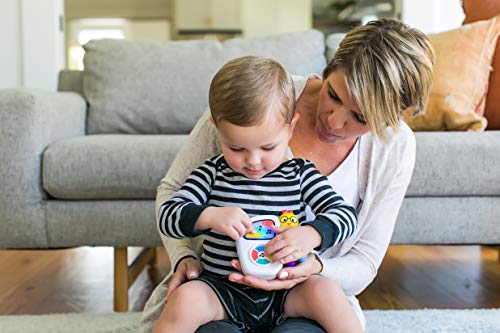
Real engagement with this toy aligns with specific developmental milestones that emerge around 6-7 months.
Motor skill development: By 6 months, most babies can press buttons deliberately. They’ve developed the finger strength and coordination needed to activate the mechanism. The large button size accommodates developing motor skills without requiring precision.
Cause-and-effect understanding: This cognitive leap typically happens between 6-9 months. Babies start grasping that their actions produce predictable consequences. Press button, music plays, press again, different music plays. That connection makes the toy engaging rather than just confusing.
Grip strength: The chunky handle becomes functional around 6 months when palmer grasp is established. Babies can hold the toy while pressing the button, coordinating both actions.
Parent feedback consistently confirms peak engagement during the 6-12 month window. Babies show sustained interest, press buttons repeatedly, respond to music, and seek out the toy during play time.
Introducing it earlier than 5 months likely won’t work. The baby can’t activate it intentionally yet, so you end up having to press it for them, which defeats the developmental purpose.
When They Outgrow It (12-15 Months Typically)
Most toddlers lose interest between 12 and 15 months, typically because the toy becomes too simple. The single-button simplicity that worked perfectly at 8 months starts feeling limited at 13-14 months.
Toddlers at this stage are developing more sophisticated play patterns. They want multiple buttons with varied responses. They’re interested in cause-and-effect relationships that go beyond simple one-to-one connections.
Expect the toy to move from daily favorite to occasional use to forgotten in the toy basket. The timeline varies by child, but 12-15 months is the common range for significant interest decline.
Some toddlers maintain casual interest up to 18 months, particularly in specific contexts like car rides. But the sustained engagement typical of the 6-12 month period fades.
Hand-me-down value is solid. If you plan to have another child within 2-3 years, this toy will survive to be reused.
Practical Engagement Window
Combining manufacturer guidelines, developmental milestones, personal experience, and parent feedback patterns suggests a realistic engagement window:
3-6 months: Usable but limited. Parents can play it for babies, but interactive engagement is minimal.
6-12 months: Peak engagement period. The toy aligns well with developmental capabilities and interests.
12-18 months: Declining interest. Still functional and safe, but competing with more complex toys.
18+ months: Typically outgrown. Most toddlers have moved on to toys with more varied interactions.
That gives a core usable lifespan of roughly 6-9 months of strong engagement. Understanding this timeline helps set realistic expectations about how long the toy will maintain regular use.
Pros & Cons
What We Like
Classical music exposure: Ten melodies from recognized composers introduce babies to music that isn’t annoying kid jingles. Parents appreciate this as much as the supposed developmental benefits.
Portability: Lightweight and compact size mean it fits in any bag. We’ve never thought twice about bringing it along.
Durability: Can handle a lot of abuse remarkably well. Other parents report longevity through multiple children.
Simple interface: One button is perfect for the 6-12-month age range. No complicated features for babies to figure out.
Volume control: Two settings beat zero settings. The low volume option makes it tolerable in quiet environments.
Easy to clean: Smooth plastic wipes down quickly. No fabric or crevices where milk and food can hide.
Good value: The price point makes it a low-risk purchase even if engagement only lasts 6-9 months.
Battery life: The included demo batteries lasted about a month with daily use. Replacement batteries run 2-3 months, depending on frequency.
What Could Be Better
Limited engagement lifespan: Six to nine months of strong use is typical before kids lose interest. Don’t expect years.
High volume too loud: Some parents find the high setting jarring.
Only 10 melodies. The selection gets repetitive for parents. More variety would help.
No off button. You have to cycle through all songs to get it to auto-shutoff, or wait for the sequence to finish.
Can’t select specific songs. No way to skip to a favorite melody or avoid one you’re tired of hearing.
Not waterproof. “Take Along” suggests durability, but moisture can damage it.
Lights are subtle. The dancing lights feature is underwhelming in bright environments.
Specifications
| Specification | Detail |
|---|---|
| Recommended Age | 3+ months (manufacturer), 6-15 months (practical) |
| Dimensions | 5.0″H × 4.8″W × 1.1″L |
| Weight | 6 oz (with batteries) |
| Battery Type | 2 AA (included) |
| Battery Life | 2-3 months with heavy daily use |
| Number of Songs | 10 classical melodies |
| Volume Settings | 2 (High and Low) |
| Materials | Hard plastic (BPA-free) |
| Handle | Yes (chunky baby-grip design) |
| Light-up Feature | Yes (subtle screen behind graphic) |
Alternatives to Consider
If You Want More Songs
VTech Baby Rattle & Sing Puppy offers 20+ songs and melodies. That’s significantly more variety than the Take Along Tunes’ seven melodies.
The price point sits in the same range. The puppy design may appeal to some babies more than the caterpillar. It’s slightly larger and less portable, though still manageable for diaper bags.
Sound quality is comparable. The extra songs help combat repetition fatigue for parents.
If You Want Longer Engagement
Fisher-Price Laugh & Learn Smart Stages Tablet grows with your baby through three “Smart Stages” covering 6-36 months.
Multiple buttons provide more complex interactions. The tablet format with screen lights appeals to babies who like visual stimulation. Different modes activate different content.
The higher price point reflects the longer usable lifespan. Engagement can extend well past the 15-month mark where the Take Along Tunes typically loses appeal.
Durability is comparable in our experience with Fisher-Price products, though the screen scratches more easily than solid plastic toys.
If You Want Better Sound Quality
Hape Baby Einstein Magic Touch Piano delivers noticeably better audio. It’s wooden construction and piano-style keys produce clearer, more accurate tones.
You’re paying 2-3 times the price of the Take Along Tunes. The sound quality difference is noticeable. More realistic tones, better resonance.
Size is the tradeoff. This is designed for stationary play, not portability. Better for home use than travel.
If exposing your baby to quality music is the priority over convenience, this is worth considering.
If Budget Is Tight
Smartphone music apps offer extensive libraries for free or minimal cost. Classical music playlists, lullabies, children’s songs. Complete control over selection and volume.
The obvious downside is screen time. Pediatric guidance recommends limiting screens for babies under 18 months. The AAP provides recommendations on media use for young children that many parents reference.
Tactile interaction is also missing. Apps don’t teach cause-and-effect the way physical buttons do.
Our take: The Take Along Tunes at its typical price point is worth it for a non-screen alternative with physical interaction.
For a comprehensive look at developmental toys across different categories, see our complete guide to the best developmental toys for babies and toddlers.
Cleaning & Maintenance
Regular Cleaning
Wipe the toy down with a damp cloth for routine cleaning. The smooth plastic surface doesn’t trap dirt or grime.
For disinfecting, baby-safe wipes work well. You can also use a cloth dampened with diluted vinegar solution. Wipe thoroughly and let air dry before giving it back to baby.
Don’t submerge it in water. It’s not waterproof despite the portability marketing.
Clean the toy weekly if it’s used daily. More often if it gets visibly dirty or goes outside.
Battery Replacement
You’ll need a small Phillips screwdriver. The battery compartment isn’t tool-free, which is actually a safety feature. Babies can’t open it accidentally.
The compartment takes 2 AA batteries. Standard size, easy to find anywhere. The included batteries lasted us 2-3 months with daily use (multiple times per day).
Using rechargeable AAs saves money over time if you plan extended use or have multiple battery-powered toys.
Replacing batteries takes about 30 seconds once you have the screwdriver. Two screws, swap batteries, replace cover, tighten screws.
Best Use Cases
Where This Toy Excels:
Car seat entertainment is the number one use case. The high volume setting cuts through road noise. The handle lets baby hold it during the ride. It provides distraction without requiring parent intervention while driving.
Tummy time gets extended when you place this just within reach. Babies push toward it, building those important core and arm muscles.
Diaper changes become easier when baby has something to hold and manipulate. It keeps their hands busy while you work.
Stroller walks benefit from the portable entertainment. Clip it to the stroller handle with a toy strap or let baby hold it. The low volume works well for outdoor ambient noise.
Travel in general is where the compact size and battery power matter most. No charging cables, no wifi needed. Just toss it in any bag.
Where It’s Less Ideal:
Long-term room entertainment doesn’t work. The toy is too simple for sustained 20-30 minute play sessions. Engagement drops after 5-10 minutes.
Quiet environments where melodies loop continuously can grate on parents. 10 songs cycling repeatedly gets old.
Babies under 5 months can’t press the button intentionally yet. You end up activating it for them, which defeats the developmental purpose.
Toddlers 15+ months find it too simple. They’ve moved on to more complex toys.
What This Toy Actually Teaches
Cause-and-Effect Learning
Press button, music plays. That direct relationship is the primary developmental benefit.
Babies around 6-9 months are just figuring out that their actions produce consequences. This toy offers immediate, consistent feedback. Every press triggers the same type of response.
The cognitive leap from “I hit this” to “I hit this because it makes music” is foundational. It carries into problem-solving and understanding how the physical world works.
Fine Motor Skills
Pressing the large button strengthens finger muscles and coordination. The action requires deliberate movement, not just random hand waving.
Gripping the handle provides practice with palmer grasp (palm and fingers wrapped around) and later pincer grasp (thumb and fingers).
Hand-eye coordination develops as babies look at the button while pressing it. They’re connecting visual input with motor output.
The repetitive practice also adds up. Hundreds of button presses over weeks build muscle memory and control.
Auditory Development
Ten different melodies expose babies to varied tempos, dynamics, and musical patterns. They hear major versus minor keys, fast versus slow rhythms.
Melody recognition develops over time. After weeks of hearing the same sequences, babies start anticipating what comes next.
The music also teaches listening rather than just hearing. Babies learn to focus on auditory information instead of letting it be background noise.
Sensory Integration
The toy combines multiple sensory inputs. Tactile (pressing button, holding handle), auditory (music), and visual (lights).
The brain practices connecting these different sensory streams. Press (tactile) creates music (auditory) and lights (visual) simultaneously.
That integration is fundamental to how babies understand their environment.
Setting Realistic Expectations
Baby Einstein products were part of an FTC settlement years ago over exaggerated educational claims. The company made promises about cognitive development that research didn’t support.
This toy won’t make your baby smarter. There’s no evidence that classical music exposure in infancy produces lasting cognitive benefits. The “Mozart effect” research was misrepresented in marketing.
What you get is entertainment that happens to align with normal developmental milestones. It’s a good toy that keeps babies engaged without screens. The learning benefits are minor side effects, not the main event.
Focus on the practical value: It provides 15-20 minutes of distraction in situations where you need it. That’s worth the price for most parents.
Frequently Asked Questions
What age is Baby Einstein Take Along Tunes best for?
Most babies start engaging with it around 6-7 months when they develop the motor skills to press the button intentionally. Peak engagement is 6-12 months, with most toddlers losing interest by 12-15 months. Babies younger than 5 months typically can’t activate it intentionally, and toddlers over 15 months often find it too simple for sustained interest.
Is the volume safe for babies?
Both volume settings are within safe ranges according to AAP guidelines on toy safety. The low setting is appropriate for close-up use like tummy time. The high setting can be jarring if placed directly near a baby’s ear, but it’s useful in noisy environments like cars. We kept it on low for 90% of our use without concerns.
How long do the batteries last?
The included batteries lasted us roughly 2-3 months with daily use (multiple times per day). That’s better than most electronic baby toys. Battery life depends on how frequently your baby presses the button. Using rechargeable AA batteries saves money over time if you plan heavy use.
Can you skip songs or just play one melody?
No. The toy cycles through all 10 melodies in order, then auto-shuts off. You can’t skip to a specific song or select a favorite. If your baby presses the button again after the seventh song finishes, it starts over at melody number one. This becomes mildly annoying if you’ve heard the same sequence 50 times.
Is it waterproof? Can I use it in the bath?
No, it’s not waterproof. Don’t use it in the bath or intentionally get it wet. Moisture can damage the speaker and electronics. For water play toys, check out our guide to the best bath toys for babies.
How do I clean it?
Wipe with a damp cloth for regular cleaning. For disinfecting, use baby-safe wipes or a cloth with diluted vinegar solution. Don’t submerge it in water or put it in the dishwasher. The smooth plastic surface cleans easily and doesn’t trap grime.
Will my baby actually learn from this?
It supports cause-and-effect learning (press equals music) and exposes babies to classical melodies. However, Baby Einstein products were part of an FTC settlement over exaggerated educational claims. This is good entertainment with minor developmental benefits, not a device that will make your baby smarter. Set realistic expectations.
Is it durable enough for a teething baby?
Yes. Ours has teeth marks on the handle from 4 months of use, but it’s structurally sound. The hard plastic holds up to gnawing better than soft toys that can tear. The handle is the main chewing target. No pieces have broken off or loosened.
Should You Buy It?
Who This Toy Is For/This Toy Makes Sense If
You want affordable entertainment for a 6-12 month old. The price point makes it low-risk even if your baby only uses it for six months.
You need portable distraction for car rides, diaper changes, or stroller walks. The compact size and battery power make it genuinely portable.
You prefer classical music over repetitive children’s jingles. Ten classical pieces from recognized composers is more pleasant for parent ears than most toy soundtracks.
You value simplicity. One button, ten songs, two volume settings. No complicated features to figure out.
You accept a 6-9 month engagement window. Understanding that most babies outgrow this by 12-15 months sets appropriate expectations.
Skip This If
You want years of use from a single toy: This isn’t a long-term investment. Parents wanting years of use from a single toy should look elsewhere. Engagement drops significantly around 12-15 months.
You need educational transformation: Anyone seeking educational transformation will be disappointed. This is entertainment with minor developmental benefits, not a learning accelerator.
You’re sensitive to repetitive music: Ten songs on loop get old. If you have a low tolerance for repeated melodies, this will annoy you.
Your baby needs quiet: Even the low volume setting is noticeable. If you prioritize silent toys, look elsewhere.
You want customization. You can’t add songs, select favorites, or control the sequence beyond skipping forward.
Buyers expecting sophisticated sound quality won’t find it here. The audio is acceptable for the price, but not impressive.
Our Bottom Line
For its price point, the Take Along Tunes delivers solid value for its 6-9 month engagement window. It’s durable, portable, and serves its purpose without pretense.
This is a simple musical toy that keeps babies entertained for 15-20 minutes at a time. It’s not revolutionary, not educational in any profound way, and not a long-term solution.
But it’s solid. Durable enough to survive baby abuse. Pleasant enough that hearing it 100 times doesn’t drive us crazy. Portable enough that we actually bring it places instead of leaving it home.
If you’re looking for classical music exposure in a baby-friendly package with genuine portability, this delivers. Just understand what you’re getting: a good toy that does its specific job well without pretending to be more.
For more options across the developmental toy category, see our guide to the best developmental toys for babies and toddlers.
Check Current Price on Amazon