Babies stare at faces before they understand much else about the world. A mirror positioned at the right height during tummy time transforms a potentially frustrating activity into something genuinely engaging for many infants. The reflection captures attention in ways that brightly colored toys sometimes don’t, particularly between 2 and 6 months when face fascination peaks.
The mirror must be shatterproof, made from acrylic or reinforced materials specifically designed for infant use. Real glass doesn’t belong anywhere near babies, regardless of framing or protective measures.
We evaluated mirrors across different categories based on parent feedback, design features, and developmental appropriateness. One pattern emerged clearly: high-contrast borders and patterns significantly increase engagement with younger babies whose vision is still developing.
Here’s something worth knowing upfront. Babies don’t actually recognize themselves in mirrors until somewhere between 18 and 24 months. Before that milestone, they’re responding to an interesting face that moves when they move, which supports visual tracking and social development even without self-awareness.
Quick Picks
Best Overall: Sassy Tummy Time Floor Mirror — Durable construction, adjustable easel back, high-contrast elements that capture infant attention effectively
Best Tummy Time Mirror: Bright Starts Sit and See Safari Floor Mirror — Large viewing area, crinkly textures, folds flat for storage and travel
Best Portable Mirror: Lamaze Captain Calamari Clip-On Toy — Multi-purpose clip attaches to car seats and strollers, multiple sensory features beyond the mirror
Best Budget: Dr.Rapeti Tummy Time Floor Mirror — Washable fabric design, high-contrast patterns, includes teethers at an accessible price point
Best High-Contrast Design: Baby Einstein Flip for Art Activity Mirror — Comes with black and white flashcards, designed specifically for developing infant vision
Best Multi-Sensory: Topsochir Baby Sensory Fish Toy — Built-in music, crinkle sounds, hidden peek-a-boo elements, plus mirror for comprehensive sensory engagement
What to Look For in Baby Mirror Toys
Safety Requirements
Shatterproof materials:
Acrylic mirrors, polycarbonate surfaces, or metallized fabric designed for baby products provide safe reflections without the catastrophic risks that come with glass. Even “baby-safe” glass mirrors don’t belong in infant play spaces. The consequences of breakage are too severe.
Mounting security:
Floor mirrors require wide, stable bases that won’t topple when babies grab the frame during tummy time. You don’t want to risk cheap mirrors with narrow bases that tip at the slightest touch. Likewise, crib-mounted mirrors need robust Velcro, strong clips, or tie systems that maintain their grip even when babies pull repeatedly. Portable mirrors that attach to car seats should use secure clips rather than stretchy elastic that can loosen over time.
Edges and frame construction:
Quality mirrors have smooth, rounded edges without sharp points where plastic molds meet imperfectly. The frame should feel solid, not flimsy. Lightweight construction helps with portability but shouldn’t compromise structural integrity to the point where the mirror flexes or bends easily.
Mirror size:
Larger mirrors give babies a better view of their reflection, which increases engagement during tummy time. But excessively large mirrors become heavy enough to cause injury if they fall on a baby. The sweet spot sits between 8 and 12 inches for dedicated tummy time mirrors. Portable versions naturally run smaller, around 5 to 7 inches, trading viewing area for travel convenience.
Age-Appropriate Features
What works for a 6-week-old differs substantially from what engages a 9-month-old. Newborns through 3 months benefit most from high-contrast borders surrounding the mirror. Infant vision develops rapidly in the first months, with babies able to track moving objects by 2 to 4 months. Black and white patterns provide the stark visual contrasts that developing eyes process most easily. Pastel colors and subtle patterns get lost in the fog of early vision.
Between 3 and 6 months, babies need clear, sizable reflections positioned appropriately for tummy time sessions. This window represents peak mirror engagement for most infants. Vision sharpens considerably, and face fascination reaches its height. A 10-inch mirror works better than a 5-inch version because babies can see more detail in their reflection and expressions.
From 6 to 12 months, additional features extend the mirror’s usefulness beyond simple reflection. Crinkle fabrics make satisfying sounds when touched. Attached rattles or teething rings give babies multiple interaction points. These extras matter because straight mirror interest typically begins declining once babies become mobile around 9 to 12 months. They’re more interested in crawling to explore actual objects than staring at reflections.
Mirror Placement and Use Cases
Floor mirrors designed for tummy time sit at baby’s eye level, roughly 8 to 12 inches from their face. This positioning encourages head lifting because babies want to maintain eye contact with the interesting face in the reflection. The visual motivation helps babies tolerate tummy time sessions that build essential neck and shoulder strength.
Crib mirrors are safe if extremely securely mounted and constructed from shatterproof materials, but the American Academy of Pediatrics doesn’t specifically endorse putting mirrors in cribs. Parents who choose this option must triple-check that the attachment system can withstand repeated pulling and grabbing to avoid the mirror falling.
Many baby gyms include mirror attachments that angle appropriately for babies lying on their backs or during tummy time. These typically provide the most versatile mounting options as babies grow and their vision changes.
Car seat mirrors let parents see their baby’s face in the rear-view mirror while giving rear-facing babies something to look at during car rides. But the attachment to the seat’s headrest must be absolutely secure. A mirror coming loose during driving creates a dangerous distraction and potential projectile hazards.
Developmental Features
High-contrast patterns are evidence-based design decisions rooted in how infant vision develops. Babies begin to smile at people and enjoy looking at faces by 2 to 3 months, and black-and-white patterns provide the clear visual boundaries that help developing eyes practice focusing and tracking.
Sensory elements beyond the mirror increase developmental value and extend engagement periods. Crinkle fabric produces auditory feedback that teaches cause and effect. Textured frames offer tactile variety for exploring fingers. Some mirrors incorporate attached toys like rattles or soft rings that give babies multiple sensory experiences in a single toy.
Babies benefit from seeing clear facial features and expressions in the reflection, even though they don’t yet understand they’re looking at themselves. Quality acrylic mirrors maintain clarity better than thin plastic alternatives that can warp or scratch easily.
The trade-off between standalone and attached mirrors involves balancing different priorities. Standalone mirrors with sturdy bases provide stability for extended tummy time sessions, but take up more storage space. Attached mirrors offer portability across different contexts like car seats, strollers, and play gyms, but may sacrifice some reflection clarity for lightweight flexibility.
Size and Portability
Dedicated tummy time mirrors perform best between 8 and 12 inches wide. This range provides sufficient reflection area for babies to see their face and upper body while remaining manageable for positioning and storage. Mirrors smaller than 8 inches force babies to get very close, limiting head movement and neck strengthening during tummy time.
Portable mirrors optimized for travel typically measure 5 to 7 inches. The reduced size makes them lightweight and diaper-bag friendly but limits what babies can see in the reflection. For primary tummy time use, this constraint proves too limiting but for car rides or stroller entertainment, the portability trade-off makes practical sense.
Lightweight mirrors travel easily but may tip when babies grab them during floor play. Heavier mirrors with solid bases stay put during tummy time but aren’t practical for packing in diaper bags. Some designs fold flat, offering stability when open and compact storage when collapsed.
Best Baby Mirror Toys Reviewed
Sassy Tummy Time Floor Mirror — Best Overall
The Sassy mirror combines the core features that matter most in a single package: shatterproof acrylic that provides clear reflections, a two-position easel back that adjusts for different developmental stages, and high-contrast black-and-white elements surrounding the mirror. The 11.5-inch square format gives babies plenty of reflection area without becoming unwieldy.
Parents consistently note that this mirror motivates reluctant tummy-timers to lift their heads and engage, which is exactly what you want from a floor mirror. The attached butterfly, ladybug, and spinning ball add visual interest without overwhelming the primary purpose. The soft frame construction provides safety margins if babies fall forward during tummy time and the build quality holds up well through weeks of grabbing and poking.

- Large True-Reflection Mirror engages babys developing vis
PROS:
- Two-position adjustable stand works for different ages
- Large true-reflection mirror with clear image quality
- High-contrast elements increase engagement
- Durable construction withstands daily use
CONS:
- Easel back can tip if the base isn’t on a completely flat surface
- Doesn’t fold for travel or compact storage
- Some babies show more interest in attached toys than the mirror itself
Bright Starts Sit and See Safari Floor Mirror — Best Tummy Time Mirror
This mirror’s design prioritizes tummy time specifically. The large viewing area and crinkly leaves surrounding the frame create an engaging sensory experience that keeps babies focused during floor sessions. It folds completely flat, which solves the storage problem that plagues many floor mirrors. The safari theme with colorful fabric and textures appeals to babies in that 4 to 9 month window when they’re developing color vision and tactile curiosity.
Parents appreciate that it stays upright during use but collapses to slip into a closet or under a crib when not needed. The mirror reflection is clear enough for babies to see facial details and expressions.
PROS:
- Folds flat for storage and travel
- Large mirror provides good viewing area
- Crinkly textures add sensory variety
- Stays upright during tummy time sessions
CONS:
- Folding mechanism can loosen over time
- Not as stable as rigid-framed alternatives
- Limited high-contrast elements for very young babies
Lamaze Captain Calamari Clip-On Toy — Best Portable
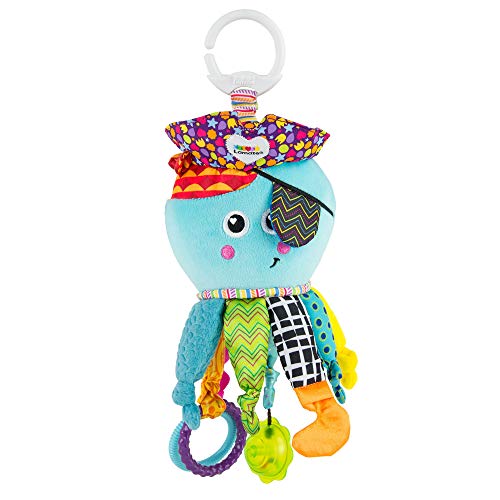
- CLIP-ON TOY: This baby toy connects easily to strollers and diaper bags
- INTERACTIVE TOY: Bright colors create visual attraction; Hat, clacking rings and rattle stimulate auditory awaren
Captain Calamari solves the portability challenge that floor mirrors can’t address. The multi-purpose clip attaches securely to car seat headrests, stroller bars, and activity gym arches.
The eight textured tentacle legs provide varied tactile experiences, and the crinkle sounds plus rattles create auditory feedback that extends interest beyond the mirror alone. It also has high-contrast colors which help capture younger babies’ attention and it’s compact size when not attached means it fits easily in diaper bags.
As a dedicated tummy time mirror, it’s too small. But for car rides, stroller walks, or general entertainment while out, it delivers exactly what parents need: a lightweight, engaging toy that won’t get left behind.
PROS:
- Clips securely to multiple surfaces
- Multiple textures and sounds extend engagement
- Lightweight and truly portable
- High-contrast design supports developing vision
CONS:
- Mirror is quite small (not ideal for tummy time)
- Too many features can overstimulate some babies
- Clip may not fit all car seat designs
- Fabric can get dirty and requires hand washing
Dr.Rapeti Tummy Time Floor Mirror — Best Budget
This fabric mirror delivers essential mirror functionality at a budget-friendly price point. The black-and-white high-contrast patterns support visual development for young infants effectively. It includes soft teethers, which add value for babies in the 4 to 8 month range.
Machine washability is a practical advantage since mirrors inevitably get drooled on and touched by sticky baby hands. The foldable design means it travels reasonably well and stores compactly. Reflection quality from the fabric mirror surface doesn’t match rigid acrylic options, appearing slightly hazier.
But for parents wanting to try mirror play without significant investment, this provides a safe, functional entry point.
PROS:
- Affordable price point
- Machine washable for easy cleaning
- High-contrast patterns suitable for newborns
- Includes teethers for dual functionality
CONS:
- Fabric mirror reflection less clear than acrylic
- Can lose shape after multiple washes
- Not as stable as hard-framed mirrors
- Protective film on mirror must be removed before first use
Baby Einstein Flip for Art Activity Mirror — Best High-Contrast Design
This mirror system pairs a baby-safe acrylic mirror with high-contrast flashcards specifically designed for developing infant vision. The black, white, and bright red cards provide the visual contrasts that newborns and young infants process most easily.
Parents can prop the mirror stand next to babies during tummy time and flip through different pattern cards or spread them out on the floor. Additionally, the cards attach via a stroller link for on-the-go entertainment. This design recognizes that infant vision remains foggy until around 6 months, and high-contrast imagery helps bring certain objects into clearer focus.
The educational approach appeals to parents who want toys with clear developmental purposes. As babies’ color vision matures around 5 to 6 months, the stark patterns become less critical.
PROS:
- Research-based high-contrast design
- Includes multiple flashcards for variety
- Transforms into a display stand
- Cards can be separated for floor play
CONS:
- Cards can get lost or damaged easily
- More expensive than simple mirrors
- Limited usefulness after 6 months when color vision develops
- Small mirror size compared to dedicated tummy time options
Topsochir Baby Sensory Fish Toy — Best Multi-Sensory
This fish-shaped toy packs remarkable sensory variety into a single package. The built-in music button, crinkle paper, squeaker, and rattle create four distinct sounds. Each colorful scale on the front features different textures, and babies can lift them to discover 14 hidden marine animals underneath for peek-a-boo games.
The soft mirror on the back provides a safe reflection without rigid edges, and the high-contrast patterns on multiple surfaces support visual development. The comprehensive sensory approach means this toy engages babies across multiple developmental areas simultaneously: auditory, tactile, visual, and fine motor skills.
It’s particularly effective for keeping babies entertained during tummy time because there’s always another element to discover. The lightweight, soft construction makes it safe for mouthing and suitable for travel.
PROS:
- Four different sound types engage auditory development
- Hidden animals under scales encourage exploration
- Soft mirror safe for all ages
- Multiple textures provide tactile variety
CONS:
- Can overstimulate some babies with too many features
- Music button may be difficult for young babies to activate
- Fabric mirror reflection quality lower than acrylic
- Complex design means more pieces that could potentially separate
B. toys Rolling Mirror — Best for Encouraging Movement

- Activity Mirror: A colorful and sensory roly-poly mirror for crawling and tummy time that stays upright when push
The rolling design transforms this mirror into a movement motivator. Two sturdy wheels keep the mirror upright as it rolls, naturally encouraging babies to push, crawl, and chase. One wheel contains colorful rattling beads, while the other features a mesmerizing spiral pattern. This dual sensory approach engages both auditory and visual attention. The roly-poly construction means it never tips over, which maintains babies’ interest because the mirror face stays visible during play.
For babies in that 6 to 10-month window when they’re developing crawling skills, the rolling feature provides compelling motivation to move. The mirror itself offers a clear reflection for visual tracking practice. This works particularly well for active babies who won’t stay put during traditional tummy time sessions.
PROS:
- Rolling design encourages crawling and movement
- Stays upright automatically due to roly-poly construction
- Two sensory wheels provide varied stimulation
- Durable for active play
CONS:
- Rolls away from babies who aren’t mobile yet
- Can be too stimulating for calm tummy time sessions
- Mirror surface can scratch with repeated floor contact
- Wheels may get stuck on carpets or uneven surfaces
Nuby Look-at-Me Mirror Teether — Best Combination Teether and Mirror

This compact toy combines teething relief with mirror entertainment in a size that babies can actually hold. The mirror measures about 5 inches, which is small for dedicated tummy time but perfect for babies to grasp and manipulate independently. Multiple silicone teething surfaces with different textures provide relief for sore gums at various eruption stages.
The toy crinkles when fabric sections are touched and rattles when shaken, creating auditory feedback. It’s genuinely portable, fitting easily in diaper bags or even large pockets. Colors vary (pink, yellow, aqua, or blue), so you can’t choose specific colors when ordering.
The food-grade silicone construction is BPA-free and safe for extended mouthing. For parents seeking a multi-purpose toy that addresses both teething discomfort and visual interest, this delivers solid value.
PROS:
- Dual-purpose teether and mirror
- Small enough for babies to hold independently
- Multiple teething textures soothe gums
- BPA-free food-grade silicone is safe for mouthing
CONS:
- Mirror too small for effective tummy time use
- Color arrives randomly (no selection option)
- The crinkle sound is relatively quiet
- May be too busy for very young babies
HABA Rainbow Baby Mirror — Best for Crib Attachment

- Whether used to admire their reflection in the mirror film, explore exciting elements like tags, loops, rings and crinkles with their fingers, teeth on the teething ring or simply lay on the backside as a pillow, babies have everything they need in the Rainbow discovery mirr
HABA designed this mirror specifically for attachment to cribs, playpens, and carriers using a hook-and-loop strap system. There are eleven sensory elements, including a crinkly knot and a teething ring, which create a varied tactile experience. The bright colors and soft textures appeal to babies once color vision develops around 4 to 6 months, and the rattling rings add auditory interest. Maintenance is straightforward, simply run it through a cold cycle in the washing machine.
The attachment system provides secure mounting when properly fastened, though the strength of the Velcro generates mixed feedback from parents. Some find it holds well across multiple surfaces, while others report it doesn’t grip as firmly as they’d prefer. For parents wanting a crib mirror option, this provides a soft, fabric-based alternative to rigid-mounted mirrors.
PROS:
- Designed for secure crib and playpen attachment
- Machine washable for easy cleaning
- Multiple textures and sensory elements
- Soft construction safe for cribs
CONS:
- Velcro strength inconsistent across different surfaces
- Mirror reflection can appear blurry compared to acrylic
- More expensive than simpler fabric mirrors
- Bright colors may overstimulate at bedtime
Genius Baby Reversible Mirror — Best Dual-Sided Design
This 14.5 by 10-inch mirror offers unique reversibility. One side provides a shatterproof mirror reflection. Flip it around and babies see high-contrast graphics in black, white, and red that support visual focus and tracking for newborns. String ties loop around crib rails, car headrests, or stroller handles for flexible attachment options. The portable carrying case facilitates travel and protects the mirror during storage.
Red is the first color young babies can distinguish beyond black and white, which makes the color choice developmentally appropriate rather than merely decorative. The rectangular shape provides good viewing area for tummy time when positioned on the floor.
Some parents report the reflection quality varies, with opinions split between those who find it clear and others who note distortion. The reversible design extends usefulness across different developmental stages.
PROS:
- Reversible for mirror or high-contrast graphics
- Large 14.5 by 10-inch viewing area
- Includes a carrying case for travel
- String ties work on multiple attachment surfaces
CONS:
- Reflection quality inconsistent according to parent reports
- String ties can loosen with repeated use
- Requires manual flipping to switch between sides
- Fabric construction less durable than rigid frames
Mobi Peeka Activity Toy — Best Versatile Positioning
Peeka’s multidimensional design stands upright, collapses flat, or hangs on doorknobs, providing positioning flexibility that most mirrors can’t match. Food-grade silicone construction is BPA and phthalate-free, safe for babies who mouth everything. The shatter-resistant mirror provides clear reflection without distortion. Textured beads and graspable handles support fine motor skill development and tactile exploration.
Due to its compact size, it folds completely flat for travel in purses or diaper bags. This versatility means one mirror works across multiple contexts: tummy time, travel, car rides, and general play. Some durability concerns emerge in parent feedback, with reports ranging from “very durable” to “breaks within weeks.” The inconsistency suggests potential quality control variability.
PROS:
- Multiple positioning options (upright, flat, hanging)
- Food-grade silicone safe for mouthing
- Compact when folded for travel
- Clear shatter-resistant mirror
CONS:
- Durability feedback highly inconsistent
- Smaller mirror limits tummy time effectiveness
- Higher price point than simpler alternatives
- Limited sensory features beyond mirror and beads
Fisher-Price Magical Musical Mirror — Best Electronic Feature Set
This light-up pretend vanity introduces early dramatic play alongside mirror interaction. Two musical learning modes deliver 30-plus songs, sounds, and phrases covering the alphabet, counting 1 to 10, colors, and opposites. Opening the compact or spinning the roller activates six dancing lights and music, and the four included accessories (comb, lipstick, bracelet, and powder puff) encourage pretend play.
This mirror toy bridges the gap between baby mirrors and toddler pretend play, making it suitable from 6 months through 3 years. Younger babies enjoy the lights and music, while older babies and toddlers engage with the accessories and role-play elements. The sound volume is moderate rather than ear-splitting, which parents appreciate. This works best for babies who’ve outgrown simple mirrors around 9 to 12 months but still benefit from the mirror component during pretend play.
PROS:
- Extensive learning content (30+ songs and phrases)
- Lights and music engage older babies
- Includes pretend play accessories
- Grows with the child from 6 months to 3 years
CONS:
- Requires 3 AA batteries (not included)
- Too stimulating for young babies under 6 months
- Electronic features can malfunction
- Larger footprint than simple mirrors
Dadoots Nibble Frame — Best Photo Frame Integration
The Nibble Frame combines silicone teething relief with a double-sided photo frame featuring a shatterproof acrylic mirror. Parents can insert photos on one side while the mirror occupies the other, creating a toy that supports both self-discovery and family recognition. The food-grade silicone frame is BPA and phthalate-free, safe for extended chewing and the CPC certification verifies infant safety standards.
The dual functionality means this toy transitions from teething relief in early infancy to a cherished photo frame that maintains relevance well beyond the teething stage. It wipes clean quickly, maintaining hygiene between uses. The photo frame feature creates a keepsake element that purely functional teethers lack. For parents wanting a thoughtful baby shower gift that combines practical teething relief with sentimental value, this delivers both.
PROS:
- Double-sided photo frame plus mirror
- Food-grade silicone safe for teething
- CPC certified for infant safety
- Wipes clean easily
CONS:
- Relatively expensive for a teether
- Photo insertion can be tricky
- Mirror side limits photo visibility during use
- Small size not ideal for tummy time
Baby Mirror Comparison Table
| Product | Best For | Key Features | Mounting/Position | Special Elements |
|---|---|---|---|---|
| Sassy Tummy Time | Overall versatility | 11.5″ mirror, high-contrast | Easel back, floor standing | Butterfly, ladybug, spinning ball |
| Bright Starts Safari | Tummy time sessions | Large viewing area | Foldable floor stand | Crinkly leaves, safari theme |
| Lamaze Calamari | Travel/portability | Compact with clip | Multi-surface clip-on | 8 textured legs, crinkle, rattle |
| Dr.Rapeti | Budget entry | High-contrast patterns | Foldable floor | Washable, includes teethers |
| Baby Einstein Flip | Visual development | Black/white flashcards | Display stand | Educational cards, stroller link |
| Topsochir Fish | Multi-sensory play | Music, sounds, mirror | Soft floor toy | Hidden animals, crinkle, rattle |
| B. toys Rolling | Movement motivation | Rolling wheels | Self-standing roller | Rattle beads, spiral pattern |
| Nuby Teether | Teething + mirror | Small handheld | Baby-held portable | Silicone teethers, crinkle, rattle |
| HABA Rainbow | Crib attachment | Fabric construction | Hook-and-loop strap | 11 sensory elements, washable |
| Genius Baby | Dual-sided use | Reversible mirror/graphics | String tie attachment | Carrying case, large size |
| Mobi Peeka | Versatile positioning | Food-grade silicone | Multiple positions | Textured beads, folds flat |
| Fisher-Price Musical | Electronic features | 30+ songs/phrases | Upright vanity | Lights, learning content, accessories |
| Dadoots Nibble | Photo frame combo | Double-sided frame | Handheld | Photo insertion, silicone teether |
Developmental Benefits by Age
Newborns enter the world with limited visual range, typically focusing best at 8 to 12 inches. That’s roughly the distance from a nursing baby to their mother’s face, which isn’t coincidental.
They’re drawn to face-like patterns and high-contrast designs from birth, though they can’t process detail or track movement effectively yet. Mirrors positioned appropriately tap into this innate face preference even when babies can’t interact meaningfully.
Between 2 and 3 months, visual tracking ability develops substantially. Babies begin smiling at people and genuinely enjoying face observation. Mirrors support this tracking practice as babies follow the reflection’s eyes and mouth movements. The progression is visible over just a few weeks. An 8-week-old might stare blankly at high-contrast borders surrounding the mirror. A 12-week-old actively tracks facial movements in the reflection.
From 3 to 6 months, Babies study faces intently, working to understand expressions and social cues. Visual clarity improves dramatically during this window.
What appeared as fuzzy shapes at 2 months becomes recognizable faces and objects by 5 months. The mirror reflection provides unlimited face-watching opportunities without requiring a parent or caregiver to sit motionless. This progression matches guidance on age-appropriate developmental toys for this stage.
Around 6 to 9 months, babies start reaching for and touching the reflection actively. They’ll pat the mirror, lean in close, and even attempt to kiss the baby looking back. This represents cause-and-effect exploration rather than self-recognition. Babies are discovering that their movements make the reflection move, which fascinates them independently of understanding they’re observing themselves.
From 9 to 12 months, mirror interest often begins declining as mobility opens new exploration opportunities. Crawling and cruising offer more engaging ways to investigate the environment than sitting and watching a reflection. Some babies maintain strong interest, especially with mirrors incorporating additional features like sounds or textures. Individual variation is substantial during this window.
The self-recognition milestone arrives much later. Self-recognition in mirrors typically doesn’t develop until 18 to 24 months, measured by the classic rouge test where a mark is placed on a child’s face. Before this age, babies enjoy mirrors as interesting visual stimuli showing a friendly, responsive face. Mirror toys support visual and motor development throughout the first year, but not self-awareness.
Mirrors also serve practical purposes beyond pure development. Many babies resist tummy time initially because lying on their stomach offers a limited, uninteresting view. Position a mirror at eye level, and suddenly there’s a fascinating face to watch.
This visual motivation encourages babies to lift their heads, strengthening the neck and shoulder muscles essential for later milestones like sitting and crawling. Some babies tolerate tummy time only when the mirror is present.
Frequently Asked Questions
When can babies start using mirror toys?
Babies can use mirrors from birth, though meaningful interaction begins around 2 to 3 months when visual tracking develops. Newborns will look at mirrors placed 8 to 12 inches away, particularly if high-contrast borders surround the reflection. Practical engagement and purposeful interaction increase significantly between 2 and 6 months as vision sharpens and face fascination intensifies. Earlier than 2 months, mirrors provide passive visual stimulation rather than active engagement.
Are baby mirrors safe?
Baby mirrors are safe when constructed from shatterproof materials like acrylic or polycarbonate and properly secured during use. Never use regular glass mirrors near babies regardless of framing. Floor mirrors require stable bases that resist tipping when grabbed. Attached mirrors need secure mounting systems that withstand repeated pulling. Verify all edges are smooth and rounded. Check attachment points regularly to ensure they haven’t loosened. Supervised use provides an additional safety margin.
Do babies recognize themselves in mirrors?
When can babies start using mirror toys?
Babies can use mirrors from birth, though meaningful interaction begins around 2 to 3 months when visual tracking develops. Newborns will look at mirrors placed 8 to 12 inches away, particularly if high-contrast borders surround the reflection. Practical engagement and purposeful interaction increase significantly between 2 and 6 months as vision sharpens and face fascination intensifies. Earlier than 2 months, mirrors provide passive visual stimulation rather than active engagement.
Are baby mirrors safe?
Baby mirrors are safe when constructed from shatterproof materials like acrylic or polycarbonate and properly secured during use. Never use regular glass mirrors near babies, regardless of framing. Floor mirrors require stable bases that resist tipping when grabbed. Attached mirrors need secure mounting systems that withstand repeated pulling. Verify all edges are smooth and rounded. Check attachment points regularly to ensure they haven’t loosened. Supervised use provides an additional safety margin.
What’s the best tummy time mirror?
The Bright Starts Sit and See Safari Floor Mirror works particularly well for tummy time due to its large viewing area and stable positioning. The Sassy Tummy Time Floor Mirror offers more positioning flexibility with its adjustable stand. Both use shatterproof materials and provide clear reflections that motivate babies to lift their heads during floor sessions. Choose based on whether you prioritize storage convenience (Bright Starts folds flat) or positioning options (Sassy adjusts angles).
Should I put a mirror in my baby’s crib?
You can put a mirror in your baby’s crib if it’s very securely mounted and constructed from shatterproof material. The American Academy of Pediatrics doesn’t specifically recommend or discourage crib mirrors. Attachment security is absolutely critical. The mirror must withstand repeated pulling and grabbing without any possibility of falling on your baby. Many parents prefer floor mirrors or play mat attachments that avoid mounting risks entirely while still providing mirror engagement.
How long do babies stay interested in mirrors?
Peak mirror interest typically occurs between 2 and 9 months. Interest often declines around 12 months once babies become mobile and find crawling to explore actual objects more engaging than watching reflections. Individual babies vary substantially. Some maintain enthusiasm through 15 months, while others lose interest by 8 or 9 months. Additional features like crinkle sounds, music, or textured elements can extend engagement periods for older babies beyond simple reflection.
Final Thoughts
The Sassy Tummy Time Floor Mirror delivers the core combination most families need: clear acrylic reflection, adjustable positioning, and high-contrast elements that capture infant attention across the critical 2 to 9 month window. For budget-conscious parents, the Dr.Rapeti mirror offers washable fabric construction and high-contrast patterns at an accessible price point, with some reflection quality trade-offs.
Safety requirements aren’t flexible. Shatterproof materials and secure mounting matter more than any developmental feature or interactive element. These standards protect babies during exploration while they investigate their fascinating reflection.
Mirrors prove particularly valuable for motivating reluctant tummy-timers. The visual interest helps babies tolerate and eventually enjoy the floor sessions that build essential neck and upper body strength. Peak engagement runs from roughly 2 months through 9 months, with substantial individual variation beyond those general boundaries.
Self-recognition arrives later than many parents expect, typically between 18 and 24 months rather than during infancy. Your 6-month-old isn’t admiring themselves. They’re fascinated by a responsive face that moves when they move, which supports visual tracking and social-emotional development even without self-awareness. For additional options supporting early development, see our guide to developmental toys for babies. As babies become mobile around 6 to 9 months, balls for babies often provide more engaging movement-based play than stationary mirrors.